Cart
0
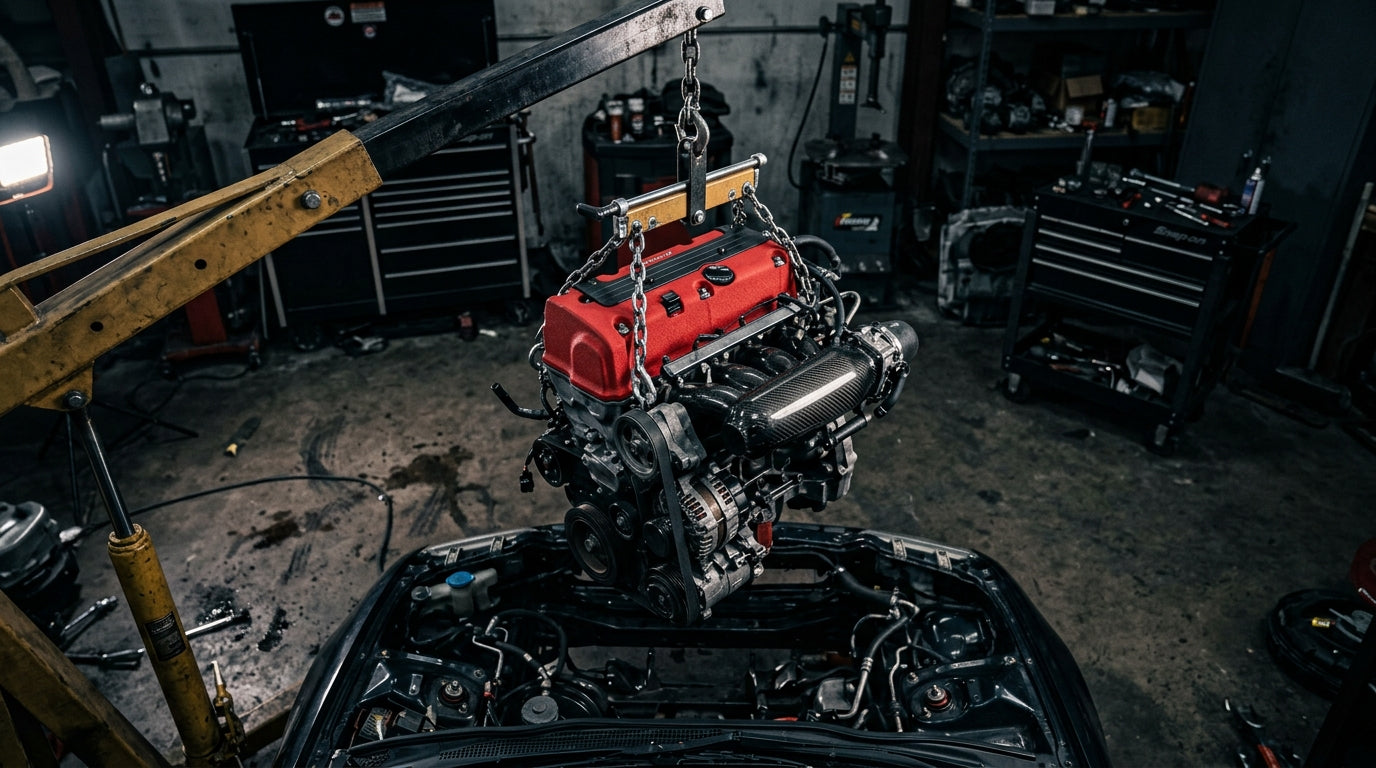
The K-series swap is the most documented engine swap in the Honda enthusiast world. Whether you're building a track Civic, a quick daily EK, or a purpose-built EP3, the K-swap offers modern power in a well-understood package. This guide covers engine selection, supporting parts, and what the full build actually costs. For the K20A vs K24A head-to-head, see our dedicated K20A vs K24A comparison.
Browse our JDM engine inventory
Browse our JDM engine inventory →
Which K-series engine for your build?
| Engine | Best application | Price (our stock) | Character |
|---|---|---|---|
| K20A (JDM Type R) | Performance builds, time attack, spirited street | $749–$1,749 | High-revving, peak power at ~7,000+ RPM |
| K24A | Torquey street builds, daily driving, budget hybrid | $849–$1,749 | More low-end torque, broader powerband |
The most popular choice for performance-oriented EG/EK swaps is the JDM K20A — not the USDM K20A2 (from the RSX Type-S) but the genuine JDM K20A from the JDM Civic Type R (EP3) or Integra Type R (DC5). The cam profiles and compression ratio are different from the USDM version, and that difference is measurable on the dyno.
For street-biased builds or builds that prioritize torque over peak power, the K24A from a CR-V, Accord, or Element provides more displacement and better low-RPM pull at a similar price point. Some builders do a "K24/K20 hybrid" — K24 block with K20 head — to get the displacement advantage of the 2.4L with the higher-flowing head from the Type R. See our K20A vs K24A guide for the full hybrid breakdown.
Chassis compatibility: which Civic platforms K-swap
For a broader framework on assessing fitment — mount kit requirements, ECU compatibility, and axle verification across any platform — see our engine fitment guide.
For a broader framework on assessing fitment — mount kit requirements, ECU compatibility, and axle verification across any platform — see our engine fitment guide.
- EG chassis (1992–1995): K-swap requires mounts, transmission, axles, and wiring. High-clearance firewall sometimes needed for K24 headers. Most popular lightweight K-swap platform.
- EK chassis (1996–2000): similar to EG; slightly more engine bay clearance in some variants. Also very popular.
- EP3 (2002–2005, Civic Si): the EP3 actually came with a USDM K20A2; the JDM K20A is a direct-spec swap (same mount points) needing ECU work and a tune.
- DC2/DC5 Integra: the DC5 RSX chassis is K-series native (K20A2 from factory); JDM K20A is a spec upgrade.
Supporting parts list for a Civic EG/EK K-swap
For a complete parts reference that covers any JDM engine swap (not only K-series), see our full swap parts list. The K-specific items below are in addition to the universal components covered there.
For a complete parts reference that covers any JDM engine swap (not only K-series), see our full swap parts list. The K-specific items below are in addition to the universal components covered there.
- K-swap mount kit: Hasport, Innovative, or equivalent. ~$300–$500 depending on configuration.
- Transmission: K20 or K24 gearbox (cable or hydraulic depending on chassis). Budget $300–$600.
- Axles: chassis-specific K-swap axles (EG or EK). Don't assume OEM axles fit. ~$150–$300 for the pair.
- Wiring harness adapter or conversion harness: OBD1 (EG) or OBD2 (EK) to K-series ECU pinout. $150–$300.
- ECU: JDM K20A ECU (if importing JDM management), or aftermarket standalone (Hondata KPro is the most common). KPro: ~$700–$900 new.
- Shifter linkage: OEM or short-throw aftermarket. $80–$200.
- Supporting ancillaries: power steering elimination or conversion if applicable; alternator brackets for accessories from your donor engine.
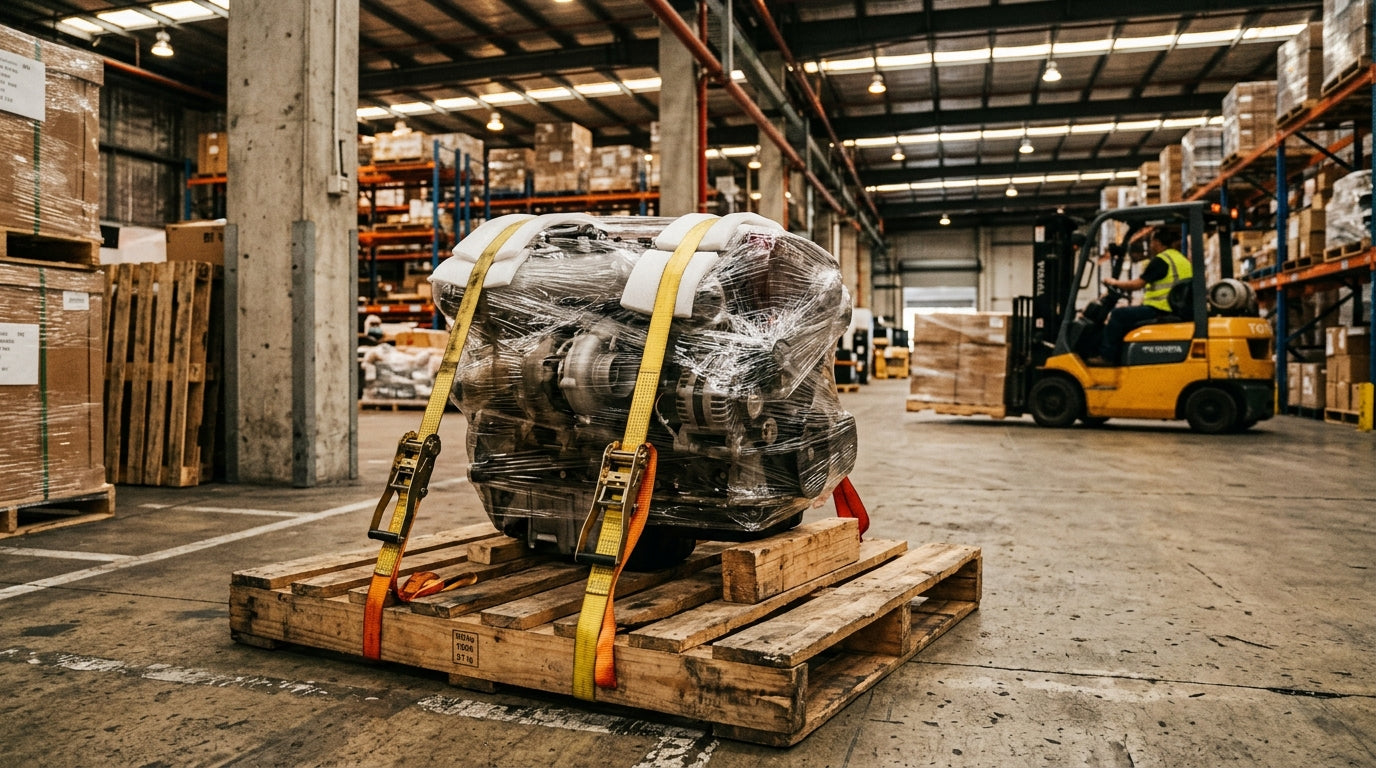
When your engine ships, see our freight shipping guide for receiving best practices — K-series engines ship as LTL freight and require proper inspection at delivery.
When your engine ships, see our freight shipping guide for receiving best practices — K-series engines ship as LTL freight and require proper inspection at delivery.
Total K-swap cost estimate
Engine only ($749–$1,749) + supporting parts ($1,200–$2,000 for a budget EG/EK build with KPro ECU) + labor if not DIY ($800–$2,000 at a shop familiar with K-swaps). All-in range for a complete street K-swap: $2,800–$5,700 depending on spec level and labor situation. See our engine cost guide for broader pricing context. Once the engine arrives, work through our installation checklist before the first startup.
Frequently asked questions
Do I need to tune a K-swap after installation?
Yes. A K20A or K24A running a foreign ECU or base map needs a proper tune to run safely and make correct power. The Hondata KPro on a JDM K20A is the most common solution — it allows precise calibration for your specific injectors, intake, exhaust, and VTEC parameters. Don't skip the tune.
What K transmission should I use in an EG swap?
The most common choice is the K20A2 transmission from an RSX Type-S (6-speed, close ratio) or the K24 transmission from a Accord/Element for more gear spread and torque handling. Confirm the transmission input shaft matches your chosen engine before ordering axles.
Is a K-swap worth it over a B-series in an EG/EK?
For a modern build targeting 200+ hp, yes — the K-series head flow, modern engine management options, and broader displacement range make it the better long-term investment. The B-series is simpler for a budget build or for preserving a period-correct build, but the K-series is the current default for modern Honda performance builds.
Can a K-series engine handle turbo boost?
Yes, with the right supporting modifications. The K20A’s high-compression ratio (11:1) means lower boost levels are needed compared to a purpose-built turbo engine like the SR20DET, but the K-series has a mature forced-induction aftermarket with documented builds to 350–450 hp on the stock block. Key requirements: appropriate fuel management, intercooler, and if targeting higher power, a lower-compression short block. For a deeper look at platforms designed specifically around boost, see our best JDM engines for turbo builds guide.
Can a K-series engine handle turbo boost?
Yes, with the right supporting modifications. The K20A’s high-compression ratio (11:1) means lower boost levels are needed compared to a purpose-built turbo engine like the SR20DET, but the K-series has a mature forced-induction aftermarket with documented builds to 350–450 hp on the stock block. Key requirements: appropriate fuel management, intercooler, and if targeting higher power, a lower-compression short block. For a deeper look at platforms designed specifically around boost, see our best JDM engines for turbo builds guide.
Shop K-series engines
Browse K20A engines, K24A engines, and our full Honda engine lineup. See the full JDM engine inventory.