Cart
0
The JDM Subaru Engine Buyer's Guide: EJ, FA20, and FB Series Explained
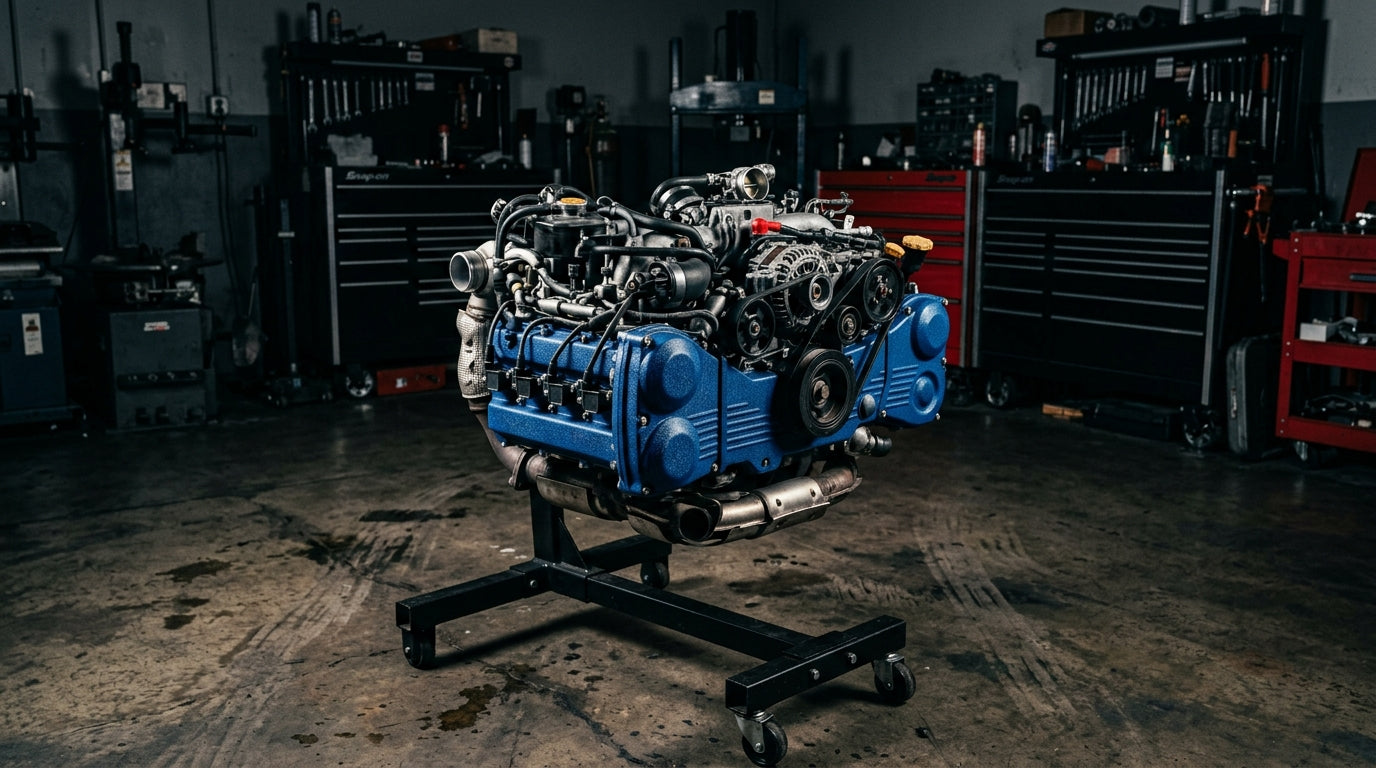
Subaru builds one of the most distinctive engine families in the JDM market — horizontally-opposed boxer engines that keep the center of gravity low and produce a flat torque curve no inline or V-layout can replicate. Whether you're replacing a blown EJ257 in a WRX STI, sourcing an FA20E for a BRZ rebuild, or refreshing a Legacy with an FB25, the JDM import market offers a well-suited option for every Subaru application.
Looking for a Subaru engine? Browse our in-stock JDM Subaru engines →
This guide covers every Subaru engine family available as low-mileage JDM imports: the EJ series (EJ20, EJ205, EJ255, EJ257), the FA20 family (FA20DIT and FA20E), and the FB series (FB25 and FB20). Each section explains the engine's spec, known failure modes, and which buyer it actually fits.
EJ Series: The Legacy Performance Platform
The EJ series is Subaru's foundational performance architecture, built across three decades and responsible for every WRX and STI generation up through the mid-2010s. These are horizontally-opposed engines built around equal-length headers and AVCS (Active Valve Control System) for variable cam timing. Within the EJ family, deck configuration, displacement, and phase number are the critical variables — and getting them wrong means mismatched hardware from day one.
EJ20 — Naturally Aspirated Base Engine
The EJ20 is a 2.0L boxer found in base Impreza and Legacy models in naturally aspirated form. It is a low-stress, high-durability replacement engine with a long JDM service history. JDM EJ20 units typically carry 40,000–70,000 miles — kept low by Japan's shaken inspection system, which creates strong financial incentives for early vehicle turnover. This engine is the right choice for owners who need reliable daily transportation rather than performance. Head gasket failure risk on the naturally aspirated EJ20 is significantly lower than on the turbocharged variants.
EJ205 — WRX-Spec Turbo (Phase I vs Phase II)
The EJ205 is the 2.0L turbocharged engine used in the JDM Impreza WRX and Forester XT, rated at approximately 211 hp in JDM spec — higher than the USDM equivalent due to tune and compression differences. The phase number is the most important detail when sourcing an EJ205: Phase I units (pre-2000) differ from Phase II in head design, AVCS calibration, and internal tolerances. Phase II units received revised heads and updated AVCS that improved low-end torque and throttle response. Confirm the phase before ordering — the intake manifold and ECU configuration on your car must match.
Known issues: head gasket failure is the most documented EJ205 problem. The open-deck block construction makes it less rigid under boost than the STI platform. A hand-selected, low-mileage JDM unit with no boost modification history carries significantly lower risk than a domestic used unit with unknown service records.
EJ255 — Higher-Output WRX Variant
The EJ255 is a 2.5L turbocharged engine used in higher-output WRX applications. Relative to the EJ205, it runs a larger turbo, a more capable intercooler, and a semi-closed deck block that improves rigidity under sustained boost. JDM output typically exceeds 230 hp stock. This is the correct replacement engine for WRX owners who want a direct swap with a meaningful performance margin over the base turbo engine.
Known issues: the EJ255 shares the EJ family's head gasket sensitivity and is susceptible to ringland failure when run at high boost without supporting modifications. Buyers should verify head gasket history before purchase. For a complete side-by-side breakdown, see our EJ255 vs EJ257 comparison.
EJ257 — STI-Spec, Fully Closed-Deck
The EJ257 is the STI engine and the strongest production unit in the EJ family. Its fully closed-deck block eliminates the open water jacket areas that make the EJ205 and EJ255 vulnerable to head gasket failure under high cylinder pressure. Add a forged crankshaft, larger displacement (2.5L), and factory boost calibrated higher than any WRX application, and the EJ257 is the clear choice for both STI replacements and performance builds targeting serious power levels. For a complete look at EJ engine architecture across the family, see our EJ engine family guide.
Known issues: the closed-deck design is more resistant to head gasket failure than the EJ255, but not immune — particularly in high-mileage or hard-driven examples. Oil consumption on aging units is documented. A quality-inspected JDM import with verified low mileage is the safer baseline than any domestic used STI engine.
FA20DIT — The Modern Turbocharged WRX Engine
The FA20DIT replaced the EJ series in the 2015+ WRX (the STI retained the EJ257 longer). It is a 2.0L engine combining direct injection and port injection with D-AVCS on both intake and exhaust camshafts. JDM output is 268 hp stock, delivered through a twin-scroll turbo that reduces boost threshold versus the EJ's single-scroll setup. The torque band is wider and flatter — a result of shorter stroke geometry and a more free-flowing head design.
The FA20DIT is becoming more common in the import market as 2015–2021 WRX owners need replacements. JDM FA20DIT units benefit from the same low-mileage advantage as earlier Subaru imports — Japan's shaken system cycles cars out early, keeping mileage within safe replacement range.
Known issues: oil dilution is the FA20DIT's most-cited problem. Direct injection leaves fuel washing cylinder walls during cold starts, which dilutes engine oil faster than port-injected engines. Monitoring oil condition and adhering to oil change intervals is non-negotiable with this engine. For broader context on failure patterns across JDM engines, see our guide on common JDM engine problems.
Is the FA20 better than the EJ series? For a modern WRX replacement, yes — the FA20DIT is technically more advanced, more fuel-efficient, and produces more stock power. For performance builds with a large existing EJ aftermarket ecosystem, the EJ257 retains an edge in parts availability and tuning documentation.
FA20E — BRZ and 86 Naturally Aspirated
The FA20E is the naturally aspirated version of the FA20 family, used in the Subaru BRZ, Toyota 86, and Scion FR-S (2012–2021). In JDM spec, the FA20E runs a higher compression ratio than its USDM counterpart, producing 200+ hp stock. That difference matters for BRZ and 86 owners who want a factory-spec rebuild without dropping to USDM output levels. Consult a certified mechanic to confirm fitment for your specific vehicle and to ensure the ECU tune is calibrated for the higher-compression JDM spec.
FB Series — Reliable Naturally Aspirated Replacements
The FB series replaced the EJ naturally aspirated engines in Subaru's mainstream lineup. These are not performance engines, but they represent a genuine reliability improvement over the EJ platform — featuring a revised head gasket design, chain-driven camshafts, and improved oil management that addresses the EJ's known weaknesses.
FB25 (2.5L): Used in the Outback, Legacy, and Forester, the FB25 is the most reliable modern Subaru platform for daily-driver replacement needs. The head gasket failure pattern endemic to the EJ naturally aspirated family is largely resolved in the FB design. JDM FB25 units are hand-selected from Japan and quality inspected before shipping.
FB20 (2.0L): Found in the Impreza and XV Crosstrek. Same strong reliability profile as the FB25 in a smaller displacement. No turbocharged FB variant exists in the JDM import market — the FA20DIT is the turbocharged successor.
Subaru Engine Buying Decision
| Use Case | Engine | Price Range | Key Notes |
|---|---|---|---|
| WRX replacement | EJ255 | $1,500–$3,500 | Match phase to your model year |
| STI replacement | EJ257 | $2,000–$4,500 | Verify closed-deck block |
| Performance swap | EJ257 or EJ255 | Varies | Verify head gasket and boost history |
| BRZ / 86 replacement | FA20E | $800–$2,000 | JDM spec = higher compression ratio |
| Modern WRX (2015+) | FA20DIT | $2,000–$4,000 | Monitor oil dilution post-install |
| Legacy / Outback / Forester | FB25 | $600–$1,800 | Most reliable modern Subaru NA platform |
For cost benchmarks across JDM engine families, see our JDM engine cost guide. For a reliability ranking across makes and platforms, see our best JDM engines for reliability guide.
Frequently Asked Questions
What is the difference between the EJ255 and EJ257?
The EJ257 uses a fully closed-deck block and a forged crankshaft — structural upgrades that make it significantly stronger under sustained high boost. The EJ255 is semi-closed deck and tuned for WRX applications rather than STI power levels. See our full EJ255 vs EJ257 comparison for a detailed breakdown of every difference.
Does the head gasket issue affect all EJ engines?
Head gasket sensitivity varies significantly within the EJ family. The EJ205 and EJ255 (open and semi-closed deck) are most susceptible, especially under boost modification. The EJ257 (closed-deck) is more resistant. Low-mileage JDM imports with no documented boost modification history carry lower risk than domestic used engines with unknown service records.
Is the FA20 better than the EJ series?
For a modern WRX replacement in a 2015+ chassis, the FA20DIT is the correct engine — more stock power, better fuel efficiency, and a modern injection system. For a performance build in an older WRX or STI chassis, the EJ257 remains the stronger choice due to its closed-deck architecture and deep aftermarket support.
What mileage should I expect on a JDM Subaru engine?
Most JDM Subaru engines arrive with 40,000–70,000 miles. Japan's shaken inspection system makes it economically rational to export or scrap vehicles well before the engine reaches end-of-life. Our engines are hand-selected from Japan, quality inspected, and backed by our warranty. Fast nationwide shipping is available on all in-stock units.