Cart
0
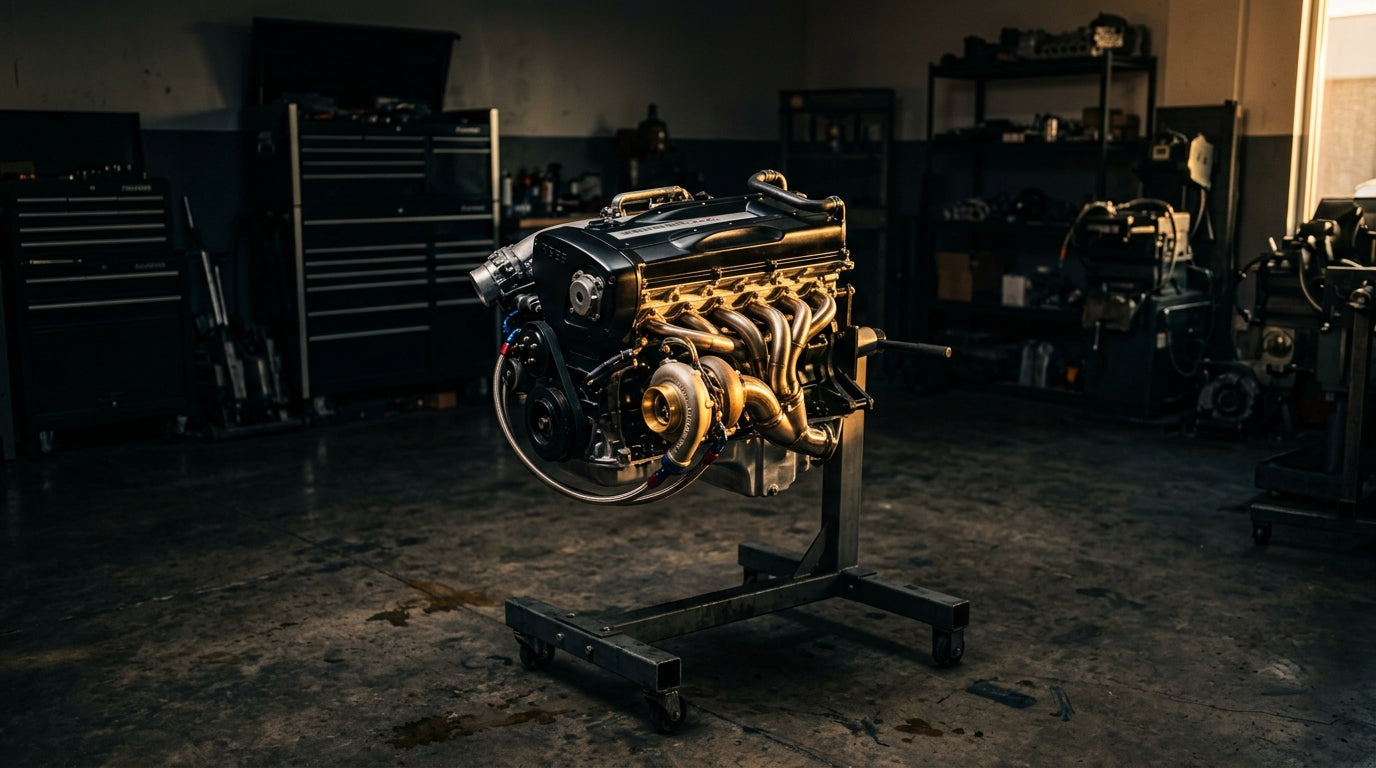
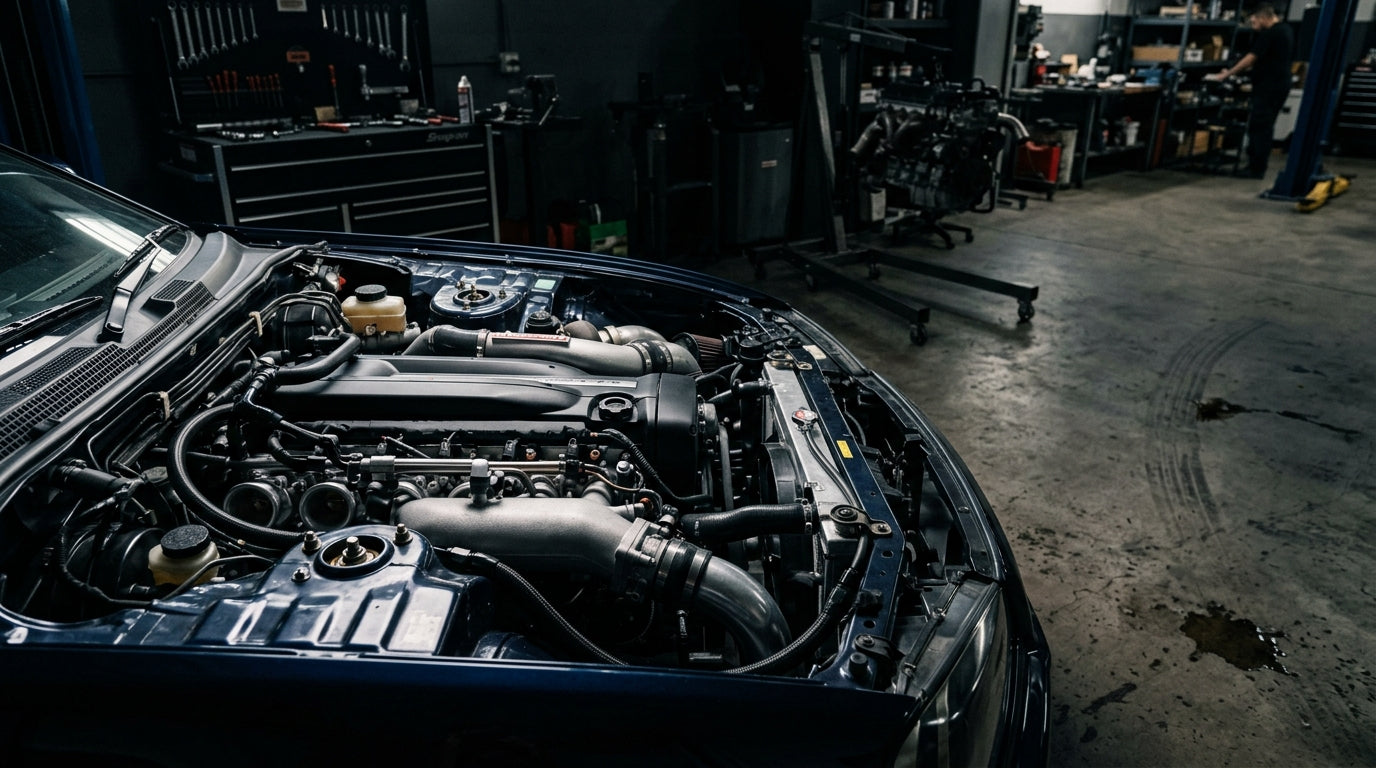
Mitsubishi and Mazda each have a handful of standout engines that drive most of the JDM import demand in their respective catalogs. This guide covers what's actually available, what each engine is built for, and what to look for when buying.
Browse Mitsubishi & Mazda engines in stock: View current inventory →
For context on JDM engine codes generally, see our engine codes guide.
Mitsubishi: The Evo Legacy and Beyond
4B11 — Lancer Evo X (2008–2015)
Mitsubishi's current-generation performance engine is the 4B11 — a 2.0L all-aluminum DOHC inline-four used in the Lancer Evo X (turbocharged as the 4B11T) and the naturally aspirated Lancer Ralliart. That distinction is critically important to confirm when buying: the turbocharged Evo X 4B11T and the naturally aspirated Ralliart 4B11 share a block family but are mechanically different configurations with different ECUs, boost systems, and output profiles. The JDM SST (dual-clutch) Evo X variant produces approximately 295 PS from the factory; the 5-speed manual version runs a different ECU calibration and slightly different fueling.
The all-aluminum block is a significant departure from older Evo engines — lighter overall, but it responds differently to aggressive tuning than an iron-block platform. MIVEC variable timing is present on the intake cam. When evaluating a 4B11T, confirm the ECU variant matches your planned drivetrain, inspect the boost controller condition, and verify head bolt integrity — stretch is a documented concern under sustained high boost. Our low-mileage JDM imports are hand-selected from Japan and quality inspected before shipping.
For builds planning to push beyond stock boost, see our turbo build engine guide for context on what the 4B11T's aluminum construction means for power ceiling planning.
4G63 — Evo I Through IX (1992–2006)
Before the 4B11, there was the 4G63 — the iron-block 2.0L DOHC turbocharged inline-four that powered every Evo from the original CD9A through the CT9A Evo IX. This is one of the most celebrated turbocharged four-cylinders in JDM history, and it remains one of the most sought-after engines in the import market for good reason.
The 4G63 spanned six Evo generations, each with distinct output and specification differences:
- Evo I (CD9A) — non-MIVEC, approximately 244 PS JDM spec
- Evo II–III (CE9A) — revised turbo and intercooler, up to 270 PS
- Evo IV–VI (CN9A/CP9A) — MIVEC introduced on Evo IV, approximately 280 PS JDM
- Evo VII–IX (CT9A) — refined MIVEC, 280 PS JDM stock across variants
What makes the 4G63 a swap legend is the iron block combined with forged internals from the factory crankshaft up. The bottom end handles significantly more cylinder pressure than most production four-cylinders without requiring immediate internal upgrades. The aftermarket ecosystem is enormous — decades of documented builds exist at every power level from mild street to 1,000+ horsepower competition applications.
What to verify when sourcing: head bolt stretch is a known pattern on previously boosted or high-mileage units; confirm timing belt condition (this is an interference engine — a failed belt causes immediate valve damage); note whether balance shafts are present, as many builders remove them during assembly. A quality-inspected 4G63 sourced through Japan's shaken inspection system will typically arrive with 40,000–70,000 miles, well within the service life of a properly maintained unit. Review our common JDM engine problems guide for timing belt service interval context.
6G72 — 3000GT VR-4 / Galant VR-4
The 6G72 is Mitsubishi's 3.0L DOHC twin-turbo V6 — the engine that powered the 3000GT VR-4 (sold as the GTO in Japan), the Galant VR-4, and in naturally aspirated form, the Diamante 3.0. The twin-turbo JDM VR-4 variant produces approximately 286 PS stock, paired with Mitsubishi's AWD system and — in the 3000GT specifically — the notoriously complex active aerodynamics package.
This is a niche engine but a genuine one. Owners of the 3000GT VR-4 or Japanese-market GTO who need a replacement engine have very few alternatives — the twin-turbo 6G72 is not interchangeable with the naturally aspirated 6G72 used across a much wider application range including Montero Sport, Eclipse, and Chrysler products. Confirm the twin-turbo configuration explicitly: the NA and TT variants do not share turbo housings, exhaust manifolds, or intercooler routing, and sourcing the wrong one creates a significant parts mismatch problem. A hand-selected, low-mileage JDM 6G72TT is backed by our warranty and ships nationwide.
Mazda: Rotary and Four-Cylinder Platforms
13B-REW — RX-7 FD3S (1992–2002)
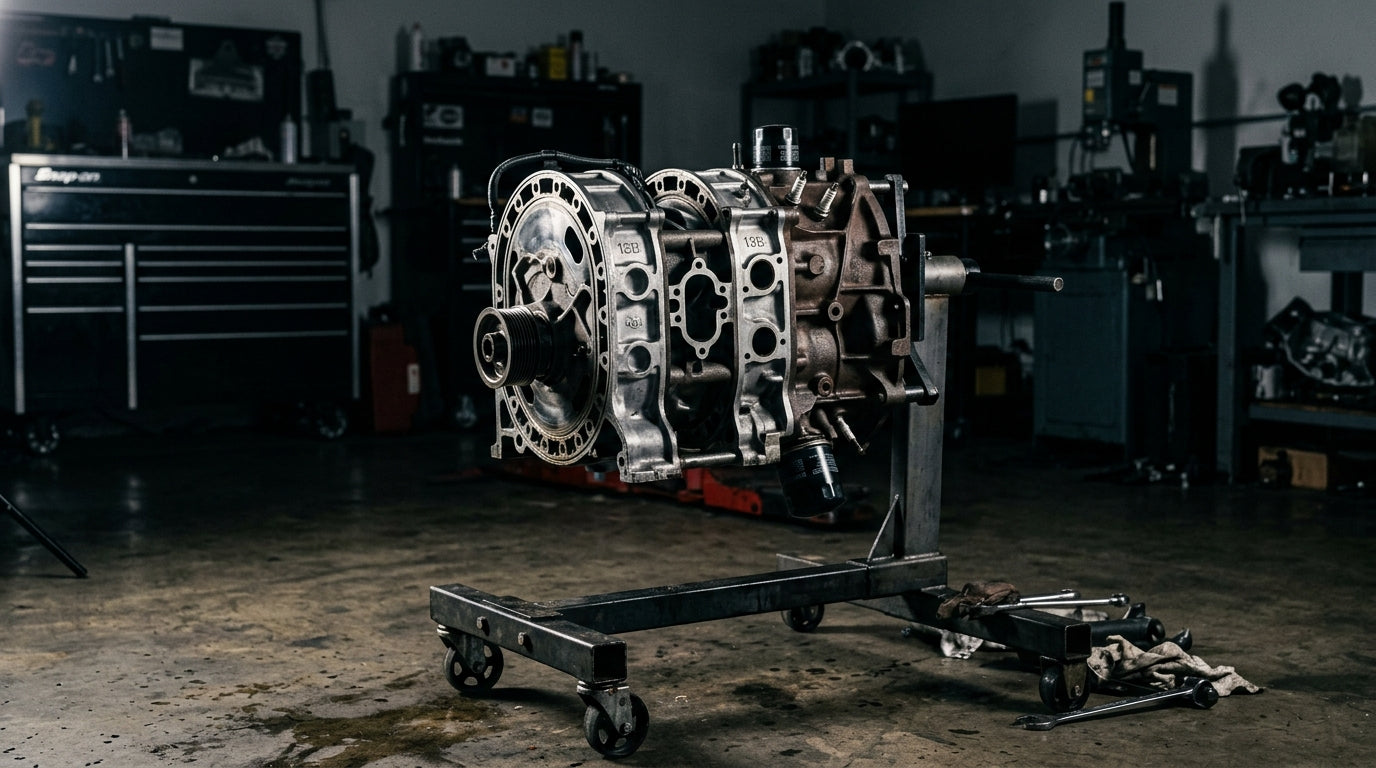
The 13B-REW is the sequential twin-turbo rotary engine that powered the FD3S RX-7 through its entire production run, producing approximately 255 PS in JDM specification. It is one of the most technically sophisticated engines to come out of Japan in the 1990s — and one that requires the most buyer-side due diligence before purchase.
A rotary engine is not a piston engine. The 13B-REW uses a triangular rotor spinning inside an epitrochoidal housing to generate combustion events — there are no cylinders, pistons, or connecting rods in the conventional sense. The maintenance profile is entirely different from any piston engine: apex seals (the functional equivalent of piston rings) wear against the rotor housing surface, rotor housings can develop scoring over time, and oil consumption management is critical — rotaries burn oil as a normal part of operation, and low oil levels cause apex seal failure rapidly.
Flooding is a documented risk on rotaries: short trips that do not fully warm the engine create condensation issues, and the starting procedure requires care. The sequential twin-turbo system — a primary turbo handling low-RPM load and a secondary turbo coming online at higher RPM via a complex transition valve system — requires all components functioning correctly for proper power delivery and fuel economy.
Sourcing reality: genuinely low-mileage FD3S rotary units cost more than comparable displacement piston engines because the supply of clean, unmolested units is limited and collector demand is rising. Apex seal condition is the primary concern. This engine is appropriate for FD3S restoration or direct replacement — not a casual swap application unless you have extensive rotary-specific experience. All units are quality inspected. Consult a certified mechanic with rotary experience before installation.
PE — MX-5 Miata ND (2015–Present)
The PE engine is the 2.0L naturally aspirated DOHC four-cylinder powering the ND-generation Miata (2015+) and MX-5 RF. It produces approximately 158 horsepower in factory trim and represents Mazda's SkyActiv engineering philosophy applied to the Miata platform: a high compression ratio, lightweight reciprocating components, and a focus on throttle response and linear power delivery over peak output figures.
ND Miata owners seeking a replacement engine are the primary buyer for PE units in the JDM market. The application is straightforward — same engine, same chassis, direct fitment — consult a certified mechanic for installation. What to verify: confirm the SkyActiv variant designation, as the PE family appears in the Mazda 3 and CX-5 with sub-variants that share displacement but differ in calibration and accessory routing. The ND-sourced PE is the correct application for Miata replacement. These are mechanically simple engines with no known systemic failure modes at normal mileage — the replacement buyer is typically dealing with accident damage or a single failure event, not a recurring pattern. For a broader reliability comparison, see our JDM engines reliability guide.
KL-ZE — Millenia / Xedos (1993–2002)
The KL-ZE is Mazda's 2.5L DOHC V6, used in the Eunos 800 (the Japanese-market Millenia equivalent) and related platforms. It should not be confused with the KJ-ZEM — the Miller cycle supercharged variant that powered the Millenia S. These are mechanically distinct engines: the KL-ZE is a conventional naturally aspirated V6; the KJ-ZEM uses a Lysholm-type supercharger and a different compression ratio to achieve the Miller cycle thermodynamic advantage.
The KL-ZE also appeared in the Ford Probe GT in USDM trim as the closely related KL-DE variant. Mazda Millenia owners and occasional Probe swap builders make up the primary market for this engine. Availability varies — this is a specialty sourcing request rather than a catalog staple — and buyers should specify the exact variant before ordering. Our engine cost guide includes pricing context for specialty V6 units.
Side-by-Side Buying Guide
| Engine | Best For | Complexity | Key Verification |
|---|---|---|---|
| 4G63 | Evo I–IX replacement; proven performance builds | Moderate | Head bolts, timing belt, balance shafts |
| 4B11T | Evo X direct replacement; modern turbo platform | Moderate | ECU variant (SST vs manual), head bolt integrity |
| 6G72TT | 3000GT VR-4 / GTO replacement | High | Confirm twin-turbo vs NA variant before ordering |
| 13B-REW | FD3S RX-7 restoration or replacement only | Very High | Apex seal condition; rotary-experienced shop required |
| PE | ND Miata direct replacement | Low | SkyActiv sub-variant confirmation |
| KL-ZE | Millenia / Probe specialty swap | Low–Moderate | KL-ZE vs KJ-ZEM (Miller cycle) distinction |
Frequently Asked Questions
What's the difference between the 4G63 and 4B11?
Generation and architecture. The 4G63 is an iron-block 2.0L turbocharged inline-four that powered Evo I through IX from 1992 to 2006 — forged internals from the factory, massive aftermarket, and an iron block that handles high boost without requiring immediate internal upgrades. The 4B11 is an all-aluminum 2.0L used in the Evo X from 2008 to 2015 — lighter, with MIVEC on the intake cam, but a different tuning approach and no parts interchangeability with the 4G63. They are separate engine families that happen to share a displacement figure.
Should I rebuild or replace an RX-7 rotary?
For most owners, a quality-inspected low-mileage JDM 13B-REW is faster and more cost-predictable than a rebuild. A rebuild done correctly — new apex seals, resurfaced or replaced rotor housings, full peripheral seal refresh — costs roughly the same as a replacement unit and takes significantly more shop time. If the rotor housings have deep scoring or thermal damage, a replacement engine is almost always the better path. Either way, the work should be done by a shop with documented rotary experience. Consult a certified mechanic before deciding.
Are Evo engines reliable for daily driving?
The 4G63 and 4B11T are turbocharged performance engines designed for a specific operating profile. Properly maintained — consistent oil change intervals, appropriate warm-up cycles before hard driving, adequate cool-down time after sustained loads — they are durable engines with real daily-driver track records. The reliability challenge is that they attract buyers who modify them aggressively, which compresses the maintenance margin considerably. A stock or mildly modified Evo engine sourced as a low-mileage JDM import and maintained on schedule is a reasonable daily driver. See our reliability guide for more context on performance engines in daily use.
What Mazda engines are easiest to maintain?
The PE (ND Miata) is the simplest Mazda engine in the JDM import market — naturally aspirated, modern engineering, no forced induction and no exotic combustion geometry. The KL-ZE V6 is also mechanically conventional with a straightforward maintenance profile. The 13B-REW sits at the opposite end of the spectrum: it requires rotary-specific knowledge, rotary-specific parts sourcing, and a shop familiar with the platform. If long-term ownership simplicity is the priority, the PE is the clear choice for Mazda buyers.
Ready to source? Browse current Mitsubishi and Mazda engine inventory → Every engine is hand-selected from Japan, quality inspected, and backed by our warranty with fast nationwide shipping.