Cart
0
Nissan and Infiniti share engine platforms more thoroughly than almost any other manufacturer, which means the same engine often appears under both brand badges depending on which car it was pulled from. This guide covers the major JDM Nissan and Infiniti engine families you'll encounter in the import market — the VQ V6 line, the SR20DET four-cylinder, and the legendary RB inline-six — with specs, applications, and honest guidance on which engine fits which buyer. For a primer on how to read manufacturer codes before diving in, see our JDM engine codes explained guide.
Browse Nissan & Infiniti engines in stock: View our current inventory →
VQ35DE: The Workhorse V6
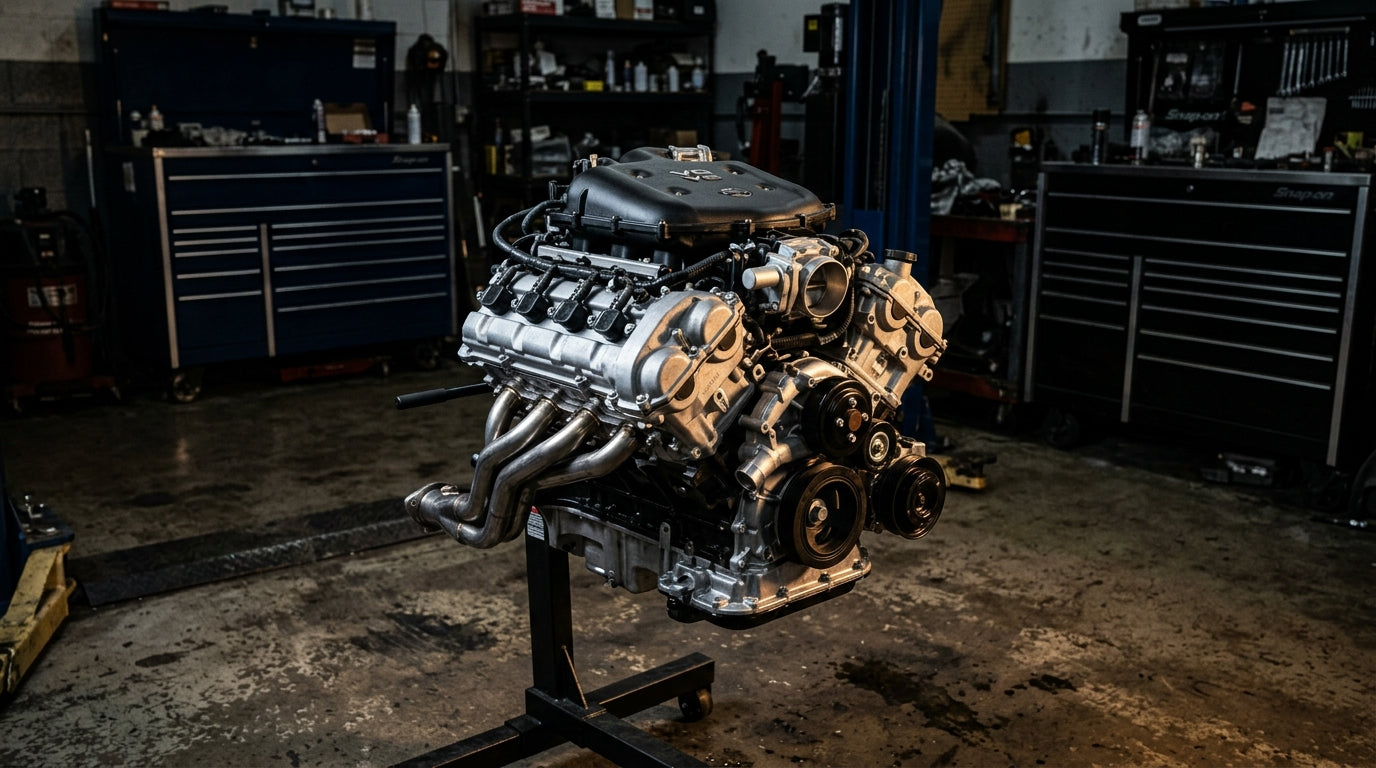
The VQ35DE is Nissan's original 3.5L V6 and one of the most proven engines in the JDM import market. It ran in production from 2002 through 2006 in the 350Z and G35, and continued in trucks, SUVs, and family sedans for years beyond that. Ward's named it one of the 10 Best Engines multiple times — a distinction earned through documented reliability, not marketing.
| Spec | VQ35DE |
|---|---|
| Displacement | 3.5L (3,498 cc) |
| Configuration | V6, DOHC, 24-valve |
| Bore × Stroke | 95.5 mm × 81.4 mm |
| Compression Ratio | 10.3:1 |
| Power Output | ~280 hp (JDM spec) |
| Torque | ~270 lb-ft |
| Redline | ~6,600 rpm |
| Timing | Chain (no belt service required) |
| VVT System | CVTC (intake cam only) |
Vehicle applications: 350Z (Z33), Infiniti G35 coupe and sedan (V35/V36), Nissan Altima (2002–2006), Maxima, Murano (first generation), Quest minivan. The same short-block architecture appears across this entire range, which makes parts widely available and labor well-documented.
Known strengths: The timing chain eliminates belt service entirely. Oil consumption is low through the mid-mileage range; some owners report slightly elevated consumption after 150,000 miles, which is normal for a high-revving V6 of this generation. When buying a low-mileage JDM import in the 40,000–70,000 mile range, oil consumption is rarely a concern. The VQ35DE benefits from Japan's shaken inspection system — vehicles are retired from the domestic market while still mechanically sound, giving you a head start on engine life.
For a complete head-to-head on how this engine compares to its successor, see our VQ35DE vs VQ35HR deep dive.
VQ35HR: The High-Rev Upgrade
Nissan introduced the VQ35HR ("High Rev") in 2007 for the revised 350Z and the G35/G37 coupe. The HR is not simply a refreshed DE — it received a redesigned cylinder head, a new VVEL (Variable Valve Event and Lift) system on both intake and exhaust cams, revised intake porting, and a higher compression ratio. The result is a higher redline (7,500 rpm vs the DE's 6,600 rpm) and improved top-end power without sacrificing the low-end torque that made the DE popular.
What changed from DE to HR: The VVEL system continuously varies both valve lift and duration across the rpm range, replacing the DE's simpler CVTC intake-only system. Revised combustion chamber geometry raises compression from 10.3:1 to 10.6:1. The throttle body moves from a single unit to individual throttle bodies per bank on some variants. The HR also uses a revised oil pump and updated timing chain tensioners.
Applications: 350Z (2007–2008 HR model), Infiniti G35 (2007), G37 coupe and sedan, Q60, and early Q50 (before the VQ37VHR replaced it). The HR is not interchangeable with the DE in earlier Z33 or V35 chassis without ECU and wiring harness changes — have your mechanic confirm fitment for your specific vehicle before purchasing.
The HR commands a price premium over the DE. Whether that premium is worth it depends on your application: daily drivers rarely need the HR's high-rpm advantage, while performance builds benefit from the wider powerband. See our JDM engine cost guide for current price context across both codes.
SR20DET: The Four-Cylinder Performance Standard
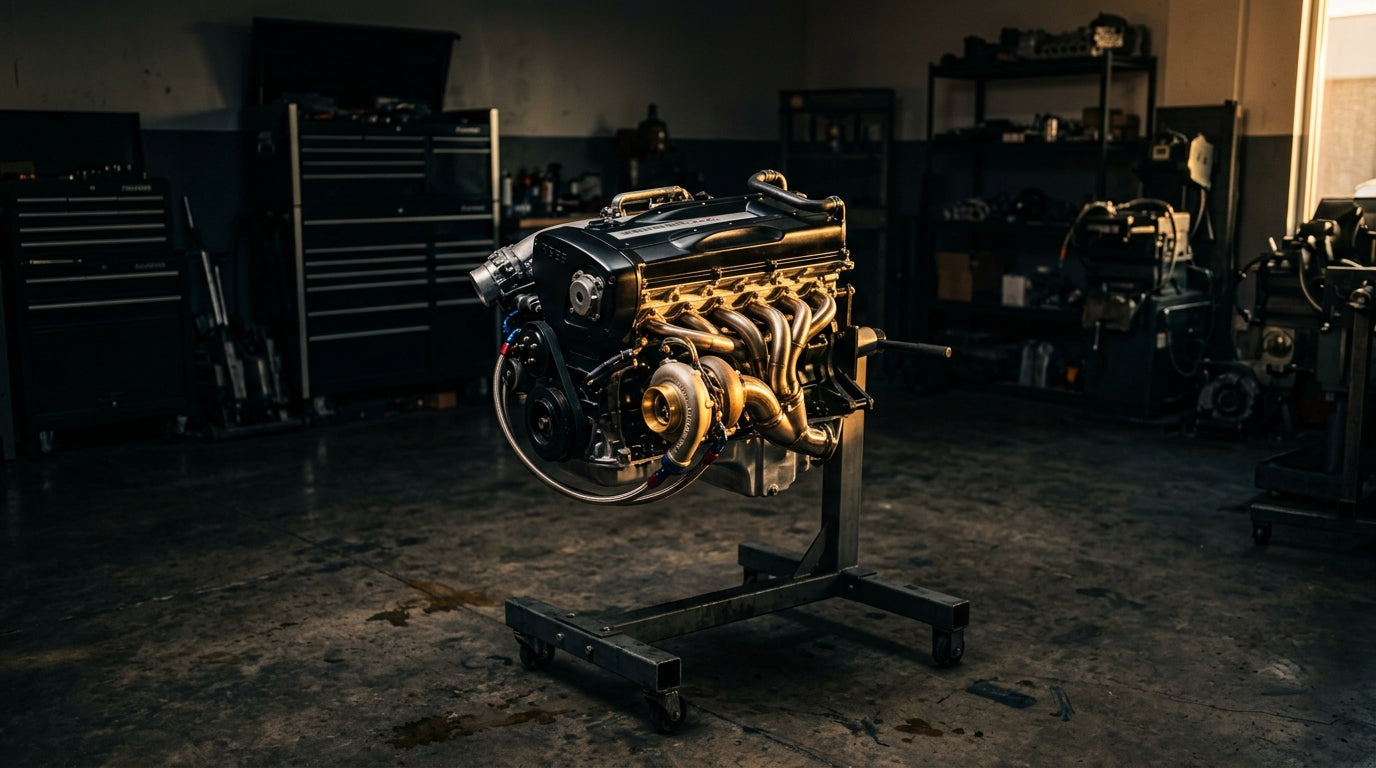
The SR20DET is a 2.0L turbocharged inline-four that defined an era of Japanese performance tuning. Factory-turbocharged from the factory, it produces 205–250 hp in stock JDM trim depending on variant and tune — numbers that were exceptional for a 2.0L in the early 1990s and remain respectable today. More importantly, the SR20DET has one of the deepest aftermarket ecosystems of any Japanese four-cylinder, which is why it remains a top swap choice decades after production ended.
| Spec | SR20DET |
|---|---|
| Displacement | 2.0L (1,998 cc) |
| Configuration | Inline-4, DOHC, turbocharged |
| Bore × Stroke | 86.0 mm × 86.0 mm (square) |
| Stock Boost | ~8–9 psi (varies by variant) |
| Power Output | 205–250 hp (JDM spec) |
| Timing | Chain |
Applications: Nissan 180SX, S13 and S14 Silvia, Bluebird (U13), Primera, and select export-market Sunny GTi-R. The SR20DET did not come in any US-market vehicle, which is what makes the JDM import the only practical source for this engine.
Red top vs black top: Collectors and tuners use these terms to describe the valve cover color, which indicates the generation. The red top (early S13 variant) has a T25 turbo and produces roughly 205 hp. The black top (S14 and later S13 variants) received a larger T28 turbo, revised head, and produces 220–250 hp depending on tune. The black top is the preferred starting point for most builds due to better stock components. Both are available as hand-selected low-mileage JDM imports through our inventory — have your mechanic confirm which variant fits your swap chassis.
The SR20DET is one of the top-ranked platforms in our best JDM engines for turbo builds guide for good reason: the square bore-and-stroke ratio responds well to increased boost, and the aftermarket has decades of documented tuning data behind it.
RB25DET vs RB26DETT: Nissan's Inline-Six Legacy
Nissan's RB inline-six family produced two engines that carry outsized significance in the JDM world. They share the same basic architecture — a 2.5L or 2.6L iron-block, DOHC inline-six — but they were built for fundamentally different purposes and carry very different price tags on the import market.
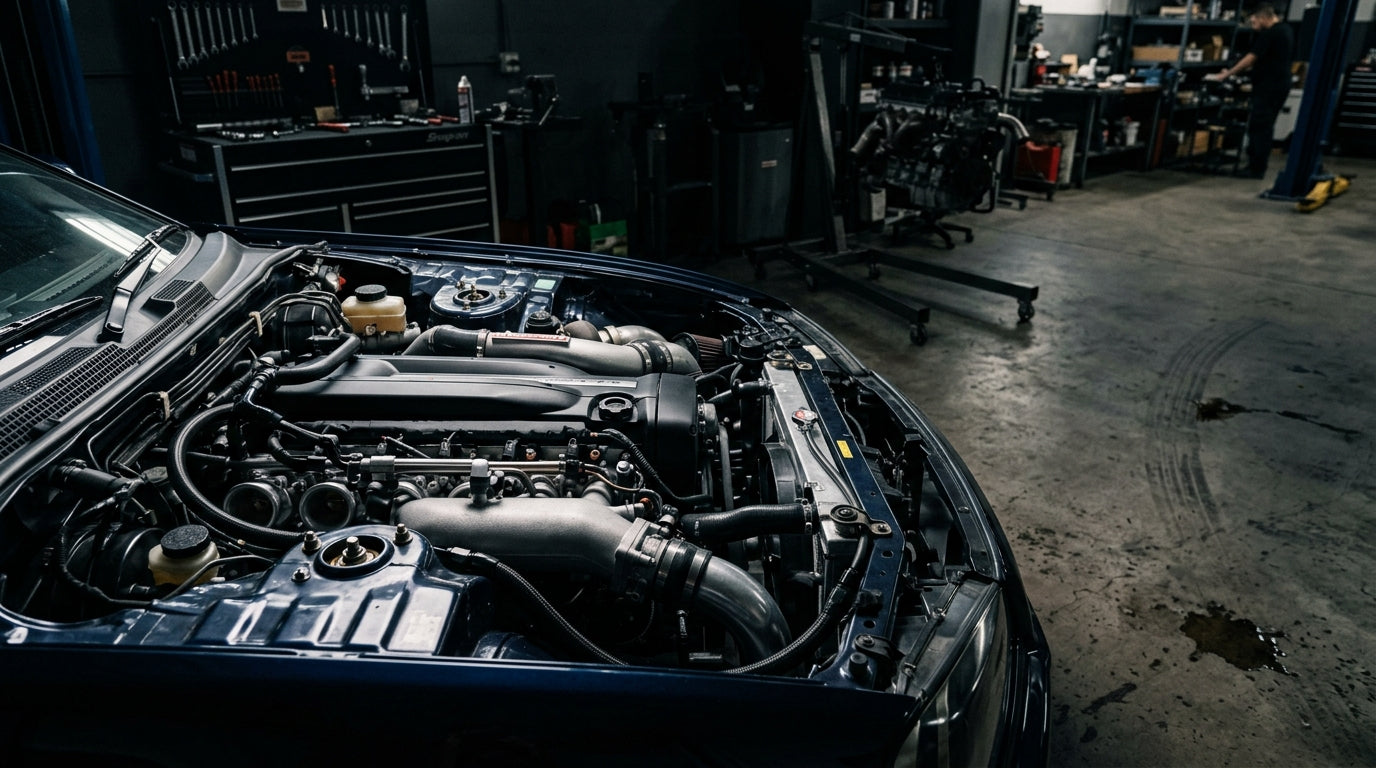
RB25DET (2.5L, single turbo): The GTS-T variant of the R32, R33, and R34 Skyline used this engine, as did the Laurel C33/C35 and the Stagea wagon. In stock JDM trim it produces around 245–260 hp through a single CT20 or Garrett-spec turbo depending on the generation. The RB25 is a strong platform and genuinely usable on the street, with a broader powerband than the twin-turbo RB26. It's also significantly more accessible on the import market in terms of both availability and price.
RB26DETT (2.6L, twin turbo): This engine is the GT-R — used exclusively in the R32, R33, and R34 Skyline GT-R. The critical mechanical differences: the RB26 displaces 2,568 cc vs the RB25's 2,498 cc, runs individual throttle bodies (one per cylinder), and carries a factory twin-turbo arrangement producing a gentlemanly agreed 280 hp in Japanese-market trim (actual output was substantially higher). The block, head bolt pattern, and cylinder head are different from the RB25 — they are not interchangeable components. Import availability is limited and pricing reflects that scarcity. Have your mechanic confirm fitment and wiring compatibility before committing to an RB26 swap.
Which Nissan Engine Is Right for Your Build?
The right engine depends on the use case, not just the budget. Here's how we think about it:
- Daily driver replacement (350Z, G35, Altima, Maxima): VQ35DE. Timing chain, wide parts availability, proven long-term reliability, and the lowest entry price in the VQ family. See our best JDM engines for reliability guide for how it ranks across all brands.
- Performance street build: SR20DET (if building a 240SX or chassis-swapping) or VQ35HR (if staying in the Z/G platform). Both reward bolt-on modifications without requiring internal work at moderate power levels.
- Time attack or track build: RB26DETT if the budget and chassis support it. The RB26 has documented builds well past 600 whp on the stock block with supporting work. The SR20DET is a capable alternative at a lower entry cost.
- Budget performance build: SR20DET black top. Lower acquisition cost than the RB series, more affordable supporting parts, and a tuning community that has solved nearly every problem you'll encounter.
All engines we carry are quality inspected low-mileage JDM imports, hand-selected from Japan and backed by our warranty. Read our warranty guide to understand exactly what that coverage includes before you buy.
Frequently Asked Questions
What mileage is normal for a JDM Nissan engine?
Most JDM Nissan engines arrive in the 40,000–70,000 mile range. Japan's shaken inspection system makes it economically rational to retire vehicles before they accumulate heavy mileage, which is why imported units consistently land in this range. For more context, see our guide on what low mileage actually means for a JDM engine.
What's the difference between the SR20DE and SR20DET?
The SR20DE is naturally aspirated; the SR20DET has a factory turbocharger. The "T" suffix indicates turbo across most Nissan engine codes. The two engines share the same basic block and cylinder head architecture, but the DET adds a turbocharger, intercooler, revised fuel system, and a higher-output ECU tune from the factory. They are not interchangeable without significant modification.
Can I swap an RB26 into a US-spec Skyline?
The R32 GT-R was never officially sold in the US, so there is no "US-spec Skyline" in the conventional sense. If you're building an R32, R33, or R34 GT-R that was imported under the 25-year rule, the RB26DETT is the factory engine and a period-correct replacement. Swapping an RB26 into a non-GT-R chassis requires engine management, wiring harness, and cooling system work — have a certified mechanic map out the full scope before sourcing the engine.
VQ35DE vs VQ35HR — which should I buy?
See our dedicated VQ35DE vs VQ35HR comparison for the full breakdown. The short answer: buy the DE for a stock replacement in a 2003–2006 350Z or early G35; buy the HR for a 2007+ chassis or a build that benefits from the higher redline and VVEL system.